You sell a mid-century home to design buyers by making the original design the main feature, doing only the preparation those buyers look at, and writing the listing so it names what is original. My name is Justin Borges, and character homes are what I specialize in, from Pasadena across the San Gabriel Valley. This hub gives the order to work in and the city rules that set your timeline.
Ready to move forward? Let's talk.
What do Pasadena design buyers look for in a mid-century home?
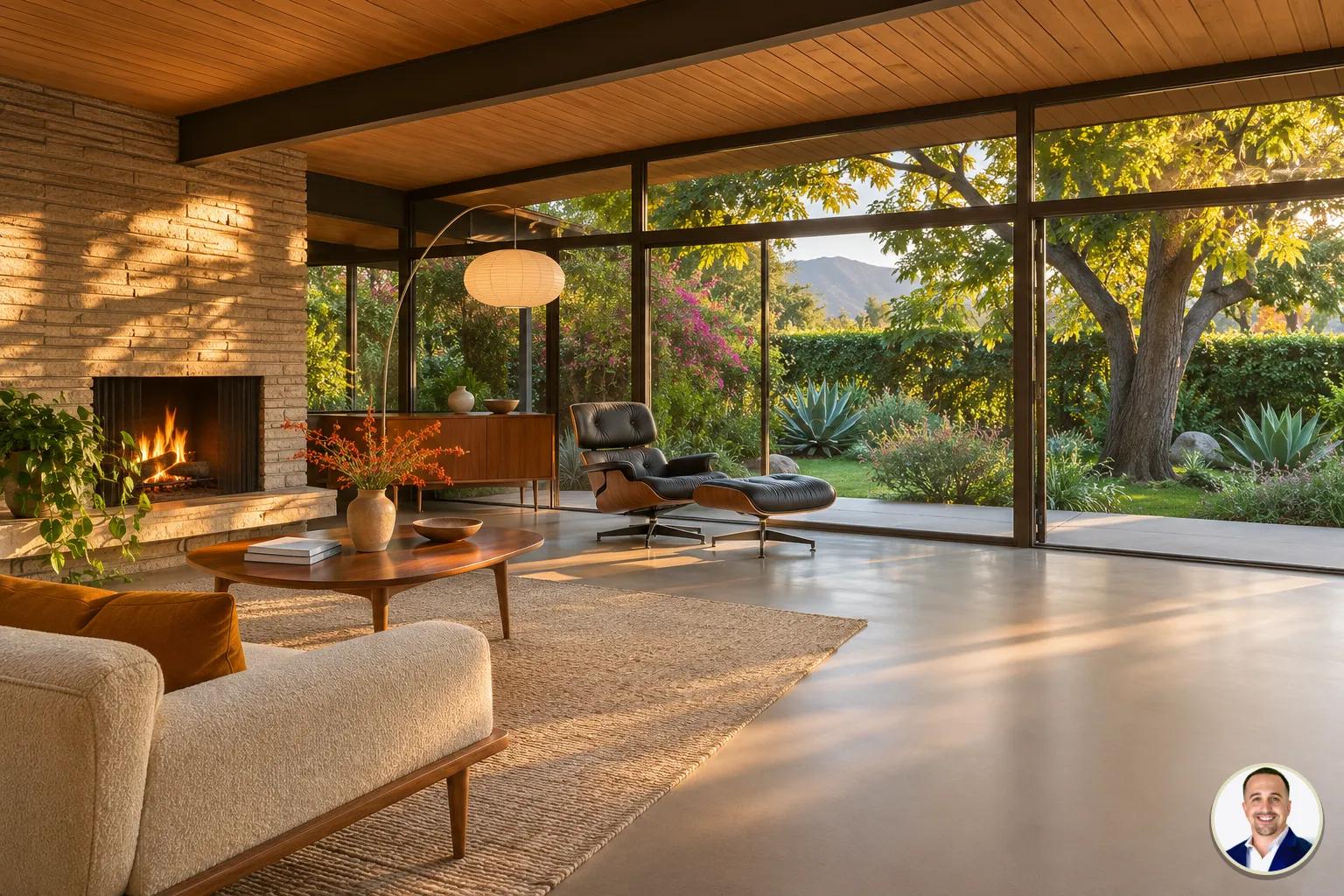
They already know the local vocabulary. The City of Pasadena historic context statement describes post-and-beam houses with an open floor plan, large expanses of glass and a close tie to the outdoors. Those are the things a design buyer expects to see when the front door opens.
That gives you the first decision. If your house still shows the city's features, sell it as a design object and keep those features visible. If later changes have buried them, you are selling a well-kept house with some design left in it, and the comparison with sold homes needs to account for the changes.
Share your feature list when you call me at (323) 673-2597, and I will tell you which features to lead with. Compare the house with the city's list first. Its historic context statement describes simple geometric forms, exterior decks and patios, and an "absence of applied ornament." For a local tract comparison, the city describes Upper Hastings Ranch as a Ranch-style subdivision, where Coronet Homes built 800 homes in 1951 on lots starting at 7,200 square feet.
Ready to move forward? Let's talk.
Is my street in a landmark district, and does that block a sale?
Look it up before you set a price or a date, because a few of the tracts design buyers love are districts. Pegfair Estates in Linda Vista was subdivided in 1961 on 200 acres and 52 lots, and within a few years nearly half the lots held custom Modern and Asian-inspired Ranch houses; a National Register form for it was prepared in 2008. The San Juan-San Polo Landmark District is 14 parcels in southeast Pasadena, subdivided in 1955 and built out by 1957 (historic context statement). The city's September 2023 map of designated historic and landmark districts also labels Poppy Peak alongside Pegfair Estates, and the city links a designated-properties database at pasadena.cfwebtools.com for address lookups.
Neither the style nor the street name tells you the status, so run the address. Text me the address and I will look up its district status.
Here is what designation changes. It affects demolitions, exterior alterations visible from the street and new construction, and each of those needs a Certificate of Appropriateness before the building permit is issued. City staff review the minor projects and the Historic Preservation Commission reviews the major ones, and every decision can be appealed. For a seller, the rule that matters most is the city's FAQ line: "Landmark district designation does not affect the use or sale of the property."
Ready to move forward? Let's talk.
How long will city review take if I change the exterior or windows?
Longer than most sellers plan for, so review sets your start date. Pasadena splits exterior work into major and minor. Under the zoning code compilation, major includes big changes to windows and doors or their openings and new exterior cladding or coating that changes how the property looks. Minor includes re-roofing in a different material that replicates the original. Major goes to the Commission and minor goes to staff, which is why windows are where I slow sellers down.
Plenty of work needs no review. The city's FAQ says interior alterations, paint colors, landscaping, solar panels and routine maintenance are exempt, and so are exterior changes nobody can see from the street. A seller who is cleaning, painting and planting does not need a Certificate of Appropriateness.
Before you schedule exterior work, call me at (323) 673-2597 with your project list and I will mark the items that need city review. A building permit is a separate clock. Simple projects that meet the city's thresholds can be reviewed over the counter in as little as 5 to 10 minutes. Plans that must be submitted take about 2 to 4 weeks per review, and those projects average three submissions, one initial and two revisions (City of Pasadena Permit Center).
Ready to move forward? Let's talk.
Which projects come before the listing, and in what order?
I recommend this sequence because the order matters more than the list.
| Step | Project | Why it sits here |
|---|---|---|
| 1 | Status lookup and any work that needs city review | It has the longest wait, so it starts first. |
| 2 | Anything broken or unsafe | Buyers and inspectors find it either way. |
| 3 | The kitchen decision | It changes the scope of everything after it. |
| 4 | Finish work and paint | Messy work waits until the big work is done. |
| 5 | Staging and photos | The camera should see the finished house. |
The kitchen is step 3. If it is original and still works, I lean toward keeping it. A permit decision on cabinet and countertop changes can affect your start date; my kitchen guide covers those questions. For any other remodel question, start with my guide on remodeling without losing value.
Staging is step 5; my staging guide covers it room by room.
To set your preparation sequence, text me your project list and I will put it in order. Before hiring for a covered renovation in a pre-1978 house, check the EPA certification and pamphlet requirements (40 CFR 745.81 and 745.84).
Pasadena's Building and Safety exempt-work handout says painting, papering, tiling and carpeting need no building permit when the work is not associated with an accessible means of egress or an accessible route. A zoning permit may still be required. Finish the work before staging and photos.
Start the status lookup and review first: Pasadena’s FAQ gives staff review as 4 to 6 weeks and Commission review as 6 to 8 weeks from submittal (City of Pasadena Planning).
Ready to move forward? Let's talk.
What must I disclose on a house built before 1978?
I tell sellers to get the Transfer Disclosure Statement out early and prepare the lead attachment before signing the sale contract. Any housing built before 1978 is target housing under 40 CFR 745.103, which covers essentially every mid-century home, and the rule says nothing about whether your house actually has lead.
Before the buyer is bound by the contract, you give the buyer the EPA lead hazard pamphlet, disclose any known lead-based paint or lead-based paint hazards, and hand over the records and reports you have (40 CFR 745.107). Put those materials with the lead attachment so the buyer can review the packet before becoming bound. The 10 days people talk about belongs to the buyer: you must allow the buyer a 10-day period to have a lead inspection or risk assessment before the buyer is bound, the parties can change that period only by mutual written agreement, and the buyer can waive it in writing (40 CFR 745.110).
Bring your disclosure paperwork questions when you call me at (323) 673-2597, and I will walk you through the forms for your house. California adds its own paperwork. The Transfer Disclosure Statement must reach the buyer as soon as practicable before title transfers; if it, or a material amendment, arrives after the offer is signed, the buyer has 3 days to cancel when it is handed over in person and 5 days when it is mailed or sent electronically (Civil Code 1102.3).
The Natural Hazard Disclosure Statement covers six zones: federal flood hazard, dam-failure flooding, high or very high fire hazard severity, wildland fire risk, earthquake fault and seismic hazard (Civil Code 1103.2). For a Pasadena hillside house, start by reading the fire and seismic lines, then check the other zones too.
For a conventional light-frame dwelling with one to four units built before January 1, 1960, the seller delivers the Homeowner's Guide to Earthquake Safety with an earthquake hazards disclosure; a 1960 to 1977 house is outside that rule (Government Code 8897.1). Check the build year and construction of an older Pasadena tract house before preparing the packet.
If the house carries a Mills Act contract, give it to buyers early. Pasadena's zoning code says the contract runs 10 years minimum, renews yearly on its anniversary and binds all successors-in-interest (Zoning Code 17.62).
Keep your copy of the signed lead attachment: the seller and agent must each retain it for at least 3 years after the sale closes (40 CFR 745.113).
Ready to move forward? Let's talk.
How do I write the listing so it names what is original?
Walk through the house before writing the remarks. List the post-and-beam structure, clerestory windows, metal-frame windows, open plan and connection to the patio where the house has them. Check records before calling a feature original: windows may have been replaced since construction.
Then make the description easy to picture. Put the design features buyers can see near the front of the remarks, and use photos that show how the rooms and outdoor spaces connect. A wide view can establish the layout; a closer view can show the detail you have named. The photos and the words should describe the same house.
When you are drafting the listing, text me the features you plan to include and I will flag what the records need to back up. For a Pasadena house with those verified features, a sample opening might read: "Expressed post-and-beam construction frames the open living space. Clerestory windows and a patio connect the rooms to the outdoors." Use the example only where the words fit the actual house. The city's historic context statement also identifies flush-mounted metal-frame windows as part of Pasadena Modernism. Before publishing, check the permit and property records for the feature you plan to call original.
Ready to move forward? Let's talk.
How do I price and launch it with you?
I start with sold homes a design buyer would compare with yours, then compare their design features, condition and street with your house. I use those comparisons to discuss a listing price with you, taking account of what remains original and the work a buyer will see. For prep, put the budget first toward things that are broken, unsafe or hurt showings; leave optional work out when it does not serve that purpose. My team also does pre-sale project management for sellers. To explore project management, call me at (323) 673-2597 with your project list and I will tell you which preparation work my team can coordinate.
Not sure your house counts as mid-century modern at all? Read what makes a home mid-century modern and how to spot one first. For one example of a sale from this era, read my Northeast LA story about a 1966 mid-century home that sold for $280K over list. It is one sale, and the right price for your home depends on its own comparable homes and condition.
For a project requiring historic review and submitted plans, build the launch schedule from the city numbers: allow 4 to 8 weeks for historic review, with a building permit delayed by about 2 months, and about 2 to 4 weeks for each submitted plan review. Then allow time for the work, staging and photos before the live date (City of Pasadena Planning and Permit Center). The city describes the permit delay as the effect of the historic review, so do not automatically add those 2 months on top of the review period.
Ready to move forward? Let's talk.
Frequently asked questions
If I change the exterior before listing, how long does Pasadena historic review take?
Listing itself needs no historic review; the requirement applies to demolition, street-visible exterior alterations and new construction. Commission cases require public notice and can take longer when other approvals or environmental studies are involved (City of Pasadena Planning). The zoning code sets a 30-day decision clock once an application is complete, unless the project needs an Initial Study or Environmental Impact Report, but I plan on the city's FAQ times.
Do I have to restore my house to its original design before I sell?
No. The city's FAQ says an owner in a landmark district is not expected to restore the house as it was originally, and it says no fee is charged for the review.
Do I have to test for lead or fix it before listing?
No. The federal rule requires disclosure and handing over any records or reports you have, but it places no duty on the seller to test, remove or pay for lead work.
Have a preparation question? Text me the details and I will tell you which step comes next.
Does owning a postwar Ranch house put me in a district?
No, not by itself. The city draft says postwar Ranch houses are more likely to be eligible as contributors to landmark or historic districts, so look the address up in the city's database before assuming either way.
Can I replace my windows without going to the Commission?
Yes, if the replacements match the design and materials of the originals and repair is infeasible, because the city treats that as a minor project for staff. Changing the openings is a major project and goes to the Commission.
How big were the original Upper Hastings Ranch homes?
About 1,300 square feet as built in 1951, with three bedrooms, one and three-quarter bathrooms, a two-car garage and a full-size fireplace. Many have changed since, so measure your own house before you write the listing.
For the kitchen decision, see my restore-or-remodel guide.
Ready to move forward? Let's talk.
Sources
- City of Pasadena, Historic Context Statement (Public Review Draft), Context: Architecture & Design (Ch. 8), checked 2026-11-20
- City of Pasadena Planning, Historic Designations & Incentives page (FAQ), checked 2026-11-20
- City of Pasadena, Designated Historic & Landmark Districts map (September 2023), checked 2026-11-20
- City of Pasadena, Chapter 17.62 Historic Preservation and related Zoning Code sections (city-hosted compilation, June 2020), checked 2026-11-20
- City of Pasadena Permit Center, Apply for a Permit, checked 2026-11-20
- City of Pasadena Building and Safety, Work Exempt from Building, Electrical, Mechanical & Plumbing Permit, checked 2026-11-20
- 40 CFR 745.103 (eCFR), checked 2026-11-20
- 40 CFR 745.107 (eCFR), checked 2026-11-20
- 40 CFR 745.110 (eCFR), checked 2026-11-20
- 40 CFR 745.113 (eCFR), checked 2026-11-20
- 40 CFR 745.81-745.84 (eCFR) and EPA, Lead Renovation, Repair and Painting Program, checked 2026-11-20
- California Civil Code 1102.3 (california.public.law mirror; the official site was bot-walled), checked 2026-11-20
- California Civil Code 1103.2 (california.public.law mirror; the official site was bot-walled), checked 2026-11-20
- California Government Code 8897.1 (california.public.law mirror), checked 2026-11-20
- How a 1966 Mid-Century Home in Northeast LA Sold for $280K Over List (The Borges Real Estate Team), checked 2026-11-20
If a source leaves a question about your house, call me at (323) 673-2597 and I will tell you how it applies.

Justin Borges
Team Lead, The Borges Real Estate TeamDRE #01940318
With over 13 years in Southern California real estate, Justin specializes in probate sales, trust properties, and character homes.