

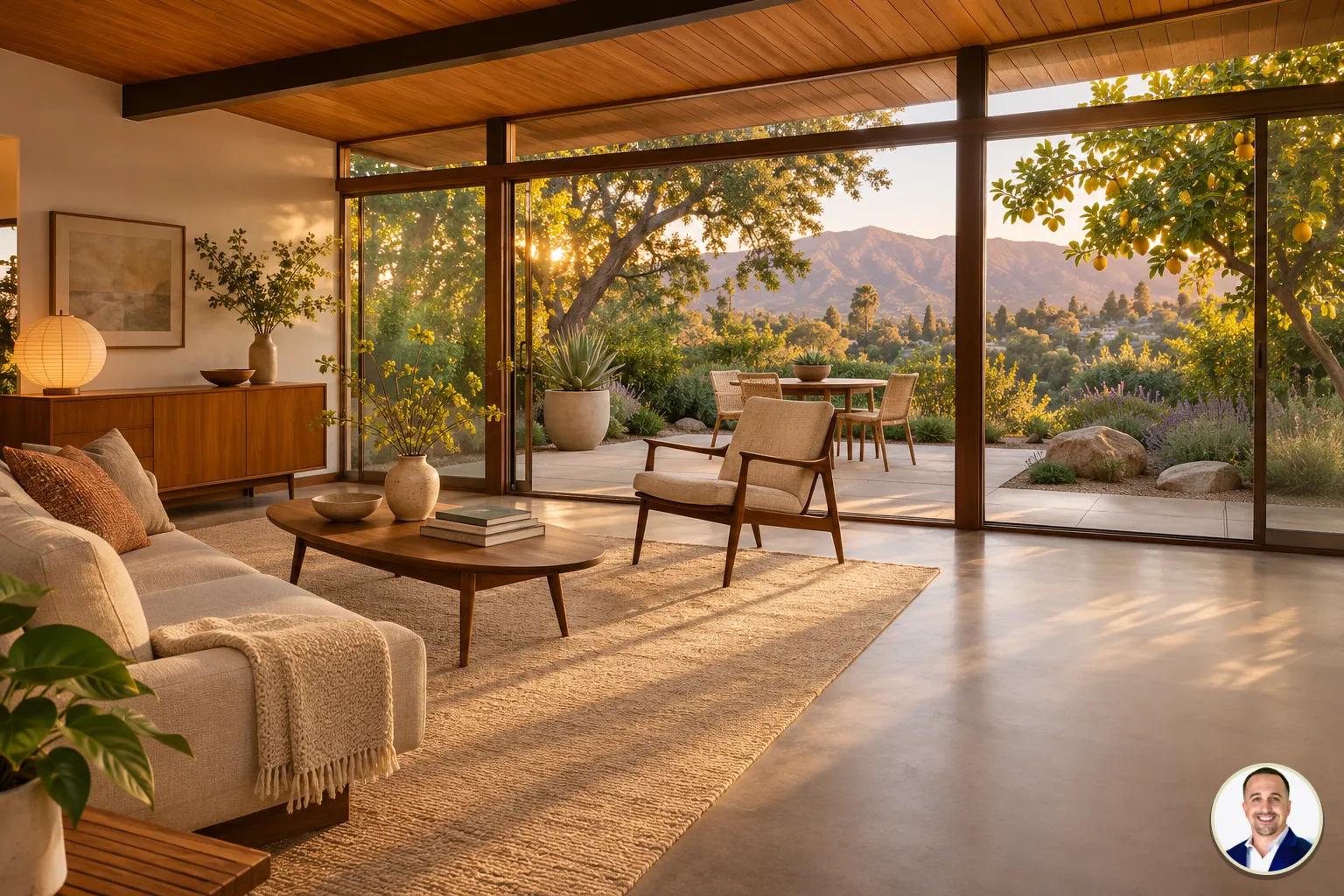
I’m Justin Borges, and I specialize in character homes in Pasadena and the San Gabriel Valley. I stage a mid-century home by clearing space so its lines, glass and original details take focus, using fewer, period-friendly pieces and warm neutral tones while showing the connection to the outdoors. See my Northeast LA mid-century sale story (The Borges Real Estate Team, checked 2026-11-20).
What do I clear out first so the lines and glass show?
I start at the front door and walk the route a buyer will take. Before choosing pillows or arranging a shelf, I look for anything that interrupts the view into the living space or draws attention away from a window, ceiling or built-in feature. Remove the extra small tables, stacks, personal collections and furniture that make that route feel crowded. Leave enough in the room to explain how it works.
Stand at the entry again after removing things. Can you see where the room leads? Can you notice the window and the shape of the space before noticing the furniture?
Keep changes in floor level visible when placing furniture: Pasadena’s Case Study House #10 follows its sloping San Rafael hillside site with rooms on several levels, according to the City of Pasadena historic context statement (public review draft), checked 2026-11-20.
Ready to move forward? Let's talk.
How do I place furniture in a mid-century living room?
I choose the main seating piece for the room’s actual dimensions, then arrange the rest around conversation and circulation. A sofa with a low, simple profile can let the eye travel across the room. Chairs can define a sitting area without forming a wall across the glass. I leave breathing room around each piece so the floor and the edges of the room remain visible.
Place a rug to connect the seating rather than cover every visible part of the floor. A modest table gives the grouping a purpose; a tall cabinet in front of a window can compete with the very feature a buyer came to see. If a piece looks attractive on its own but blocks a route or conceals a built-in, I move it.
Warm neutrals can connect the furnishings without making every surface the same color. I use texture and a little contrast in the furniture and accessories, while letting existing wood, masonry or other original materials carry the visual weight.
If you want a second set of eyes on your layout, call me at (323) 673-2597 and we can walk through the rooms.
Ready to move forward? Let's talk.
How do I stage the patio and the walls of glass?
I treat the outdoor view as part of the room and keep the path to it open.
Clean the glass and clear items from the window line. Open the existing coverings for photography and showings, unless privacy calls for keeping them closed, and check what a buyer sees through the glass: a tangled hose, a stack of pots or an unused chair can pull attention away from the setting. Outside, arrange a small seating area where it reads naturally from the room, leaving the door and walkway clear.
Keep plants and outdoor furniture below the sightline so the yard remains visible.
Walk the route in both directions. The patio should feel usable once a buyer steps outside, and the interior should still look open from the yard. I put away maintenance supplies and leave the path between the living room and patio clear.
In Pasadena’s Frank House, almost every room connects directly to the outdoors, with a slate floor, exposed wood ceiling and brick fireplace, according to the City of Pasadena historic context statement (public review draft), checked 2026-11-20.
You can text me if you want to talk through an awkward indoor-outdoor layout.
Ready to move forward? Let's talk.
What do I leave out of a mid-century home?
I leave out pieces that obscure the features we are trying to show. Heavy drapes can conceal the shape and extent of a window; an oversized sectional can turn an open room into a barrier. Too many small accessories can have the same effect in miniature, making a shelf or counter look busy instead of letting its form register.
| Set aside | Use instead |
|---|---|
| Heavy drapes covering glass | Open coverings while respecting privacy |
| Oversized seating blocking a route | Furniture scaled to the room |
| Crowded counters and shelves | A few useful, restrained objects |
That does not mean stripping the home bare. A lamp, a book or a bowl can make a room feel lived in. I edit until each object has space around it and the buyer can see the built-ins, floor and windows without working past a collection of things.
For a staging conversation, call me at (323) 673-2597. For a broader look at the selling process, read my guide to selling a mid-century home to buyers who love design. If the kitchen itself raises a bigger question, see whether to restore or remodel a mid-century kitchen before selling.
To identify the features you may want to bring forward, start with what makes a home mid-century modern.
Ready to move forward? Let's talk.
How should the photos show the design?
I plan photos around the features a buyer should understand before visiting: the room’s proportions, its connection to the next space, the windows and the route outdoors. Before the photographer arrives, I stand in the likely camera positions and look for cords, clutter or furniture edges that cut across those views. Then I walk outside and check the view back toward the house.
You can text me to talk through the order of preparation before photography.
If a listing agent uses an image altered to add, remove or change elements, California Business and Professions Code section 10140.8 requires a conspicuous statement on or next to the image and a link, URL or QR code to the unaltered original; basic lighting, color, cropping and straightening edits are excluded when they do not change the property’s representation (checked 2026-11-20).
Ready to move forward? Let's talk.
What is my room-by-room staging checklist?
I begin with a walk-through, clear the main route, arrange the largest furniture, and then finish the smaller rooms and outdoor areas. Once the rooms are ready, I review the views for photos. You do not have to hire a stager: start by moving furniture that blocks a window or a main route before paying for additional decor. If you are considering a stager, get a staging quote and skip it if the quote is higher than the likely price gain.
- Entry: Remove extra furniture and personal items, and make the route into the living area clear.
- Living room: Scale seating to the space, open the window line and let built-ins and floors show.
- Dining area: Leave enough room to walk around the table and keep its surface simple.
- Kitchen: Clear counters and show the existing cabinets and surfaces without covering them with decor.
- Bedrooms: Simplify bedding and bedside surfaces, and leave access to doors and windows open.
- Bathrooms: Put personal products away and leave the counters clean and easy to see.
- Patio and yard: Clear the path from the house, remove stored items and set out a modest place to sit.
For help deciding what to tackle first, call me at (323) 673-2597 and we can start with the walk-through.
Ready to move forward? Let's talk.
Frequently asked questions
Should I remove every personal item before photos?
No. In a Pasadena mid-century home, I clear personal collections and crowded surfaces first, then leave a few restrained objects that give the room a sense of use without hiding built-ins or windows.
Can I keep a large sofa in the living room?
Yes, if it fits without blocking the glass, circulation or the view of the room. I move it away from those features or replace it for photos and showings if it dominates the space.
Should every window be uncovered?
No. I open existing window coverings for photos and showings unless privacy calls for keeping them closed. My goal is to show the glass and the view without making the room feel exposed.
For a plan tailored to your rooms, text me.
What should I put on an empty patio?
For a San Gabriel Valley patio, I start with a modest seating arrangement and a clear route from the interior. A table or planter can help define the space without filling the view through the glass.
Do I need to buy period furniture?
No. I look for pieces with simple profiles and a scale that suits the room. They can complement the architecture without turning the home into a period display.
Where should I start if the whole house feels crowded?
I start at the entry and follow the main path toward the living room and outdoors. Clearing that route gives us a useful view of what to move next.
Sources
- City of Pasadena historic context statement (public review draft), checked 2026-11-20
- California Business and Professions Code section 10140.8, checked 2026-11-20
- Northeast LA mid-century home sold over list, checked 2026-11-20

Justin Borges
Team Lead, The Borges Real Estate TeamDRE #01940318
With over 13 years in Southern California real estate, Justin specializes in probate sales, trust properties, and character homes.