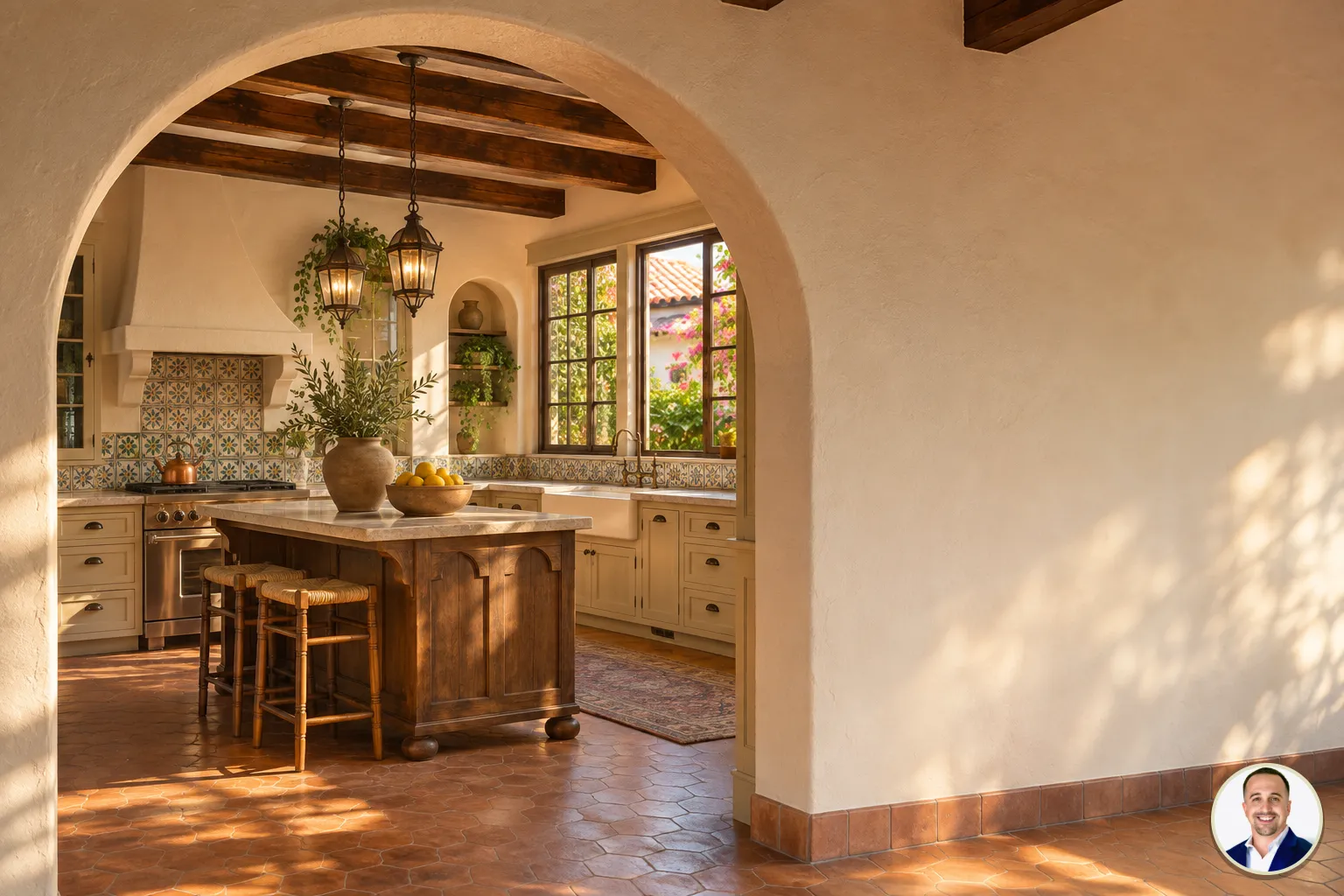
Yes, I believe you can update a Spanish Revival kitchen and bathrooms without losing their character when the work respects the stucco, arches, tile and plaster instead of erasing them. The key is to decide what gives this particular home its identity before deciding what needs to change. I’m Justin Borges, and I use this guide to help you decide where to start and which details deserve a closer look.
When I walk through a character home with a buyer or an owner, I pay attention to the feeling of moving between rooms as much as the individual finishes. A kitchen can have better storage and appliances while still belonging to the rest of the house. A bathroom can be easier to use without looking as though it was borrowed from an entirely different property.
That does not mean freezing the house in time. It means making deliberate choices: identify what is worth keeping, understand the condition behind the surfaces, and plan the new work around the features that matter.
Ready to move forward? Let's talk.
Where should you start if the kitchen or bath feels dated?
I would start with the way you live, then look closely at what is already there. Write down the frustrations you want the project to solve: a cramped preparation area, awkward storage, poor lighting or a bathroom that does not serve the household comfortably. Separately, note the details you would be disappointed to lose. Keeping those lists distinct helps you avoid treating a feature with character as the cause of every inconvenience.
Want to talk through your priorities? Call me at (323) 673-2597.
Stand in the adjoining room and look toward the kitchen or bath. Does an arch frame the entrance? Does a tile floor carry your eye through the space? Is there a plaster finish or a window that gives the room its particular feel? Those relationships can matter as much as any single decorative element. Photograph them and share the images with the people helping you plan the work.
Then decide whether the problem is mainly cosmetic, functional or related to condition. A room that works well but feels tired may call for different decisions than a room with an awkward layout or an unresolved inspection finding. The distinction gives your designer and contractor a useful starting point, not a finished prescription. Want to discuss the room? Text me about what you are considering.
For a Pasadena home, compare your photographs with the city’s historic district design guidelines. They identify recessed openings and patios among Spanish Colonial Revival features.
What should you keep, and what can change?
My starting point is to keep significant original details where their condition and your plans allow, and to make new elements support them. The National Park Service discusses evaluation of historic steel windows in its steel window preservation brief, and repair of historic plaster in its plaster preservation brief.
| Feature | Deciding test | My starting decision |
|---|---|---|
| Original ceramic floor tile | Are there only slight chips or cracks, or loose grout? | Keep and repair where possible. Fix the cause of damage before replacing tile. |
| Steel casements | Is corrosion limited, or does deterioration make repair impossible? | Repair and weatherize first; consider replacement when repair is impossible. Pasadena guidelines generally favor preservation when more than half the components can be repaired. |
| Flat plaster | Is a hairline crack in sound plaster, or does a crack appear to be expanding? | Fill a hairline crack in sound plaster. Consult a structural engineer for an expanding crack; fix moisture before replastering. |
| Arched openings | Does the arch frame a defining view between rooms? | Keep the opening in the layout and arrange new work around it. |
For original floors and bathroom surfaces, the guide to saving Spanish tile is the place to go if you are weighing preservation against replacement. The National Park Service favors preservation and repair over replacement for historic ceramic tile floors, as explained in its preservation brief.
Ready to move forward? Let's talk.
How can a kitchen work better and still feel like the house?
I would keep an arched opening that frames the kitchen and arrange the working layout around it. Put the appliances and cabinets on the same plan so storage and meal preparation work together without sacrificing that view.
Look at the floor before choosing new finishes. If original ceramic tile has slight chips, cracks or loose grout, start with repair and address the cause of damage. Choose lighting and cabinetry that sit comfortably beside the tile and plaster, then check the plan from the dining room and hall.
Ask for a cabinet elevation and a line-item scope showing what stays and what changes. If the kitchen has steel casements, Pasadena’s guidelines generally favor preservation when more than half the components can be repaired.
If you are comparing homes, call me at (323) 673-2597 to discuss what you are seeing.
What makes a bathroom update feel appropriate?
I would first see whether original floor tile can stay, then choose fixtures, lighting and storage around the features worth keeping. Loose floor tile can point to deteriorated grout or mortar; address the water source and consider repair before replacement. Pasadena’s Batchelder & Brown was known for Arts and Crafts tile.
Keep the opening and assess an original steel window before deciding to replace it. The steel casement guide helps compare the choices. For plaster, the cracked plaster guide explains the next conversation: fill a hairline crack in sound plaster, but consult a structural engineer about an expanding crack.
If you are weighing a property, text me about the features you hope to keep.
How do cooling and outdoor spaces affect the plan?
Put mechanical improvements on the plan before finalizing finishes. Request a written equipment route and permit plan before choosing equipment, so you can see how it affects the rooms and exterior you want to preserve.
For a household considering cooling, the central air guide addresses that decision in a home with plaster walls. For an owner whose kitchen or bath connects visually or physically to an outdoor space, the courtyard and patio guide offers a separate starting point for upkeep.
These questions also help a buyer compare properties. A home whose layout already supports your routines may need a different scope from one where you want to rethink several connected spaces. I would rather understand that difference while considering the property than assume every house can accommodate the same plan in the same way.
Have a property in mind? Call me at (323) 673-2597 to discuss it.
For Pasadena historic districts, the city’s guidelines place condensers away from the front facade and recommend rear or side locations. California requires a permit when an HVAC unit is replaced or altered, according to the California Energy Commission. A C-20 contractor license covers HVAC work.
Ready to move forward? Let's talk.
What should you check before buying or starting work?
For buyers, start with the property itself, not just the imagined finished room. Review available records and disclosures, arrange appropriate inspections, and ask follow-up questions about findings that could affect the scope of your plans. Ask the inspector for a written list of findings that need further evaluation, so you can request a line-item scope before choosing a design.
For a home built before 1978, the federal lead-safe renovation rule requires an EPA- or state-certified firm for covered paid work disturbing painted surfaces; see the plaster guide for details. The National Park Service warns that plaster demolition dust may contain lead and asbestos, and the EPA identifies other materials that may contain asbestos.
For owners and buyers alike, contact the city with the address and describe the work you are considering. Verify the property's historic status and ask which permits or reviews apply to your particular proposal. Do this before committing to a design that assumes an opening, window or other feature can be changed in a particular way.
For Pasadena historic status and review, start with Current Planning. For help thinking through a property, text me.
Next, bring the inspection findings, your priorities and any city guidance to the designer and contractors. Ask them to explain how their proposed work relates to the elements you want to keep. If their recommendations differ, ask why and what each choice would mean for the finished rooms. I find that a clear scope is more useful than a vague instruction to make everything look Spanish.
Have questions about a property you are considering? Call me at (323) 673-2597 to talk through the features you want to keep.
Finally, revisit the plan as a whole. Does it solve the problem that prompted the project? Can you still recognize the house in the views that mattered at the start? Are there unanswered condition or city questions that should be resolved before the work begins? Those answers give you a stronger basis for deciding what comes next.
This week, use Pasadena’s designated-property resources and Historic Property Contract Program guidelines, then contact Current Planning with the address and proposed scope; the casement guide covers historic review in more detail.
Frequently asked questions
Can I change the kitchen layout and still preserve the character?
Yes. I would first identify the openings, finishes and views that give the room its identity, then test the proposed layout against them. A plan can improve how you cook without treating every existing detail as an obstacle.
Should I keep every original feature?
No. Start by identifying the features that matter to the house and evaluating their condition. A preservation-minded professional can help you weigh repair, adaptation and replacement when a feature no longer works for your needs.
Want to discuss a home? Text me.
What should a buyer ask before planning a remodel?
Ask for available records, arrange appropriate inspections and discuss the proposed scope with the city. I also suggest bringing the people who would do the work into the conversation before relying on a listing photo or an early design sketch.
How can a bathroom feel updated without looking out of place?
Let the existing room guide the choices. Fixtures, lighting and storage can improve daily use while the tile, openings and finishes remain part of the design conversation.
Should I choose appliances before deciding on cabinets?
I would establish the layout and the appliances you need together, then ask the designer to coordinate the cabinet plan around them. That makes it easier to see how the working parts of the kitchen affect the room as a whole.
Who should I contact about permits or historic status?
Contact the city with the property address and a clear description of the proposed work. In Pasadena landmark districts, interior alterations are exempt from historic review, unless the interior is designated or the house has a recorded Historic Property Contract (Mills Act), which requires a Certificate of Appropriateness for work on historic interior features. A building permit may still be needed. Ask how to verify the designation and what reviews or permits apply before work begins.
Sources
- National Park Service, Preservation Brief 40: Preserving Historic Ceramic Tile Floors, checked 2026-11-15
- National Park Service, Preservation Brief 21: Repairing Historic Flat Plaster Walls and Ceilings, checked 2026-11-15
- City of Pasadena, Historic Property Contract Program Guidelines and Application (February 2026), checked 2026-11-15

Justin Borges
Team Lead, The Borges Real Estate TeamDRE #01940318
With over 13 years in Southern California real estate, Justin specializes in probate sales, trust properties, and character homes. His expertise in 1031 exchanges and historic preservation has helped hundreds of clients navigate complex real estate transactions.