

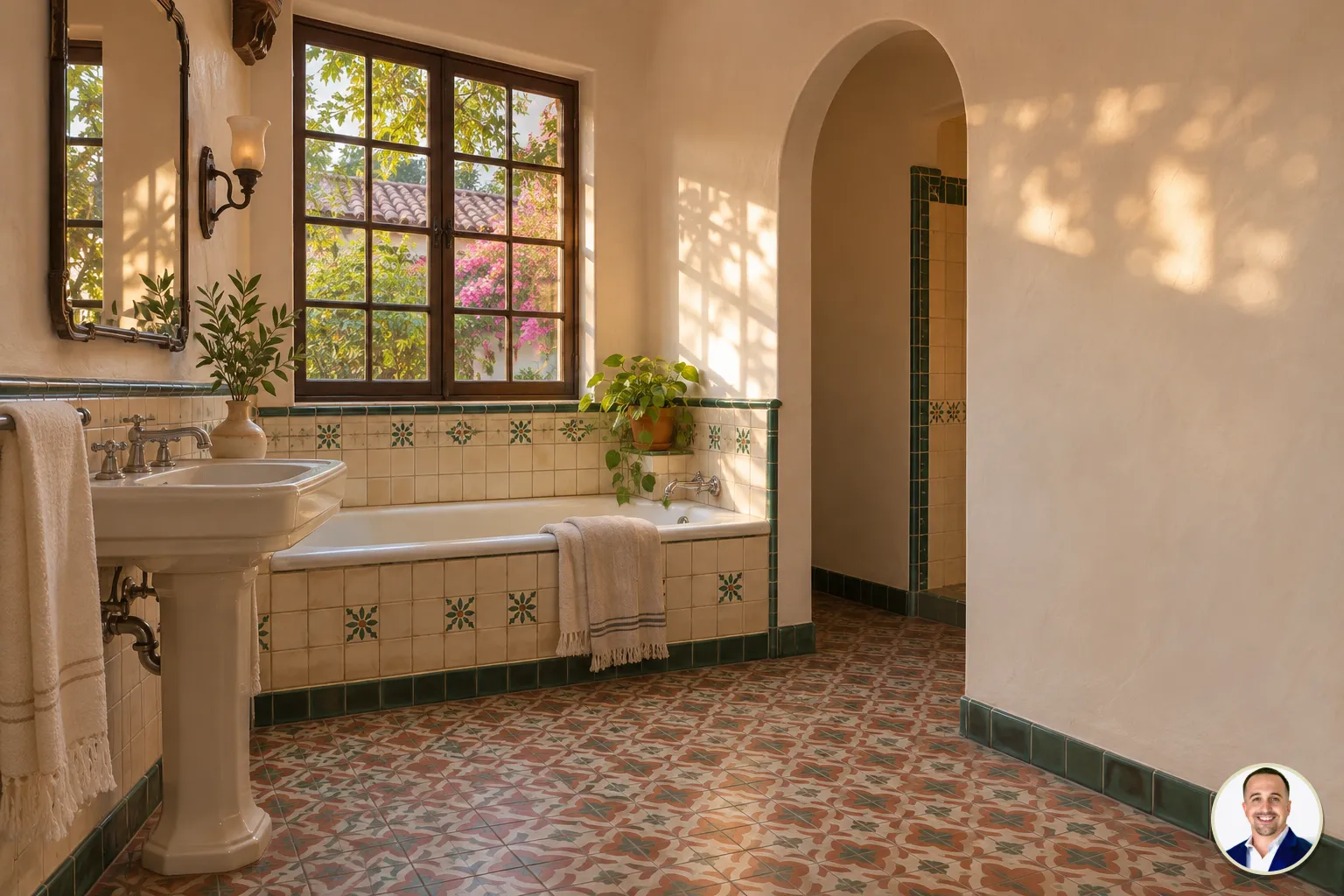
I’m Justin Borges. I tell buyers to keep sound original Spanish tile and repair worn grout or a few damaged pieces. The tile’s color and pattern contribute to a Spanish Revival home’s character. Where the substrate is wet or failing, sound original pieces can be lifted and reset after the underlying problem is corrected and the bed repaired; missing or broken pieces can be replaced.
What makes original tile worth a closer look?
In a Pasadena or San Gabriel Valley Spanish Revival home, tile can carry the room’s color and pattern from the entry through the bath. Its edges, layout and relationship to a doorway or tub are part of the design. A floor that looks tired in a listing photo may be telling you more about its surface and joints than about the condition of the whole installation.
I like to look at the complete room before planning a renovation. Notice where the pattern starts and ends, how a border meets the wall, and whether earlier work interrupted the layout. Photograph those details before anyone removes fixtures or opens a wall. The pictures give the contractor a reference for protecting the design while the practical work gets done.
The National Park Service’s Preservation Brief 40 recommends preserving and repairing historic ceramic tile floors when possible; minor chips, scratches and cracks do not automatically call for removal.
Ready to move forward? Let's talk.
How can you tell surface wear from a deeper problem?
Walk the floor and look across it in natural light. Note worn areas, chipped corners and fine surface lines, then look for tiles that rock, raised edges, missing grout and cracks that continue across several pieces. In a bath, pay particular attention to the floor beside the tub, shower and toilet, and to the joints where tiled surfaces meet fixtures.
A hollow sound during a professional tap test identifies an area for closer examination, but it is not a diagnosis. Mark the location and pair that observation with visible movement, damaged joints and the history of moisture. Avoid prying at a loose tile yourself; removing one piece can damage its neighbors.
If a floor rocks underfoot during your showing, call me at (323) 673-2597 and I can help coordinate a closer look.
Ready to move forward? Let's talk.
Where should you look for moisture damage?
Water is the issue I want investigated before anyone makes the tile look new. Water around tubs and showers can damage grout and mortar and loosen floor tile. Look for staining, damaged grout, a musty smell or deterioration on accessible surfaces adjoining the bath. Those signs warrant investigation.
Have a plumber find and correct the water source and check the substrate first; the tile contractor then decides how much tile can stay, and finishes come last. Ask for access before any destructive investigation and agree on who will restore an opened area. If a bathroom shows signs of water damage, call me at (323) 673-2597 and I can help coordinate a plumber’s investigation during your purchase.
Ready to move forward? Let's talk.
When does restoration make sense?
When the setting is stable, a targeted repair can preserve the layout while addressing the part that needs attention. The work might involve repairing deteriorated joints, resetting a loose piece or carefully replacing a small damaged area. Deteriorated mortar joints and loose mortar or grout can generally be repaired, with grout chosen to fit the existing color. Get a written scope and quote from a C-54 tile contractor before your inspection contingency ends (17 days after acceptance by default on the C.A.R. purchase agreement, and the parties can change it), so you have a real number for the work.
Ask the specialist to explain what will be cleaned and what will be removed. Request a small test of any proposed cleaning or sealer treatment in an unobtrusive spot, and ask whether the particular surface should be sealed at all. The goal is a treatment suited to the tile in front of you, not an automatic coat over every surface.
To compare the contractor’s targeted repair scope with your renovation plans, text me.
Ready to move forward? Let's talk.
When should you consider replacing tile?
Replacement makes sense for missing or broken pieces. Ask the contractor to show you the evidence for the boundary of the affected area.
| What you find | What to discuss |
|---|---|
| Wear or a few damaged pieces with a sound setting | Conservation, joint repair and targeted work |
| Loose areas or recurring cracks | Investigation of the setting and underlying cause |
| Wet or failing substrate | Lift and reset sound originals on a repaired bed; replace missing or broken pieces |
Before choosing a new surface, consider the transitions at doors, fixtures and adjoining rooms. New tile can complement the room without pretending to be original. Correct causes such as settlement or vibration before replacing damaged pieces. To talk through the contractor’s proposed replacement boundary as a buyer, call me at (323) 673-2597.
Ready to move forward? Let's talk.
Who should examine the tile before work begins?
A general home inspection gives buyers a broader view of the property and identifies visible concerns that may need a closer look. It is useful context for the bathroom, but it does not expose every concealed layer. Ask the inspector to locate concerns in the report and identify what needs a separate evaluation; read the agreement to understand what was accessible.
For the tile itself, hire a tile contractor with experience in historic work. California’s C-54 Ceramic and Mosaic Tile classification covers preparing surfaces and installing tile, including work at tubs and showers. Use the CSLB license lookup to verify the contractor’s C-54 license before signing, and ask how the contractor will assess loose areas.
Ask for a sequence that distinguishes investigation from the final repair. If opening a small area reveals more damage, the scope should explain how the finding will be documented and discussed before work expands. To coordinate the tile contractor’s visit during your purchase, text me.
Ready to move forward? Let's talk.
What should you ask the seller about the tile?
Ask about leaks, recurring dampness and repairs at the tub, shower, toilet or nearby plumbing. Request invoices, photographs and inspection or repair reports, including records of concealed work.
Give the records to the inspector to compare with visible conditions. If the seller has spare pieces, ask that they be identified in the transaction documents.
How do you protect tile during other updates?
Pasadena’s bathroom remodel handout distinguishes floor covering alone from work involving fixtures or wallboard; confirm the scope with Pasadena Building and Safety. Show every trade the surfaces to protect and discuss covering the tile and moving materials. Plumbing, electrical and heating or cooling work can damage historic tile floors, so coordinate openings and access before demolition.
For the broader choices beyond tile, see how to update kitchens and baths while keeping their character. Plan central air and plaster wall work around access, consider steel casement windows when planning window work, assess cracked plaster before finishes, and include courtyard maintenance in the wider upkeep plan.
To line up the trades around your purchase, call me at (323) 673-2597.
Frequently Asked Questions
Does a cracked tile mean the whole floor needs replacement?
No. A small crack or chip can be a localized defect. Have the cause and the surrounding setting examined before deciding how much work is needed.
Is hollow-sounding tile always failing?
Not necessarily. A hollow sound warrants closer examination alongside movement, damaged joints and any history of moisture.
Can worn bathroom tile be restored?
Often, if the setting is sound. A specialist can repair joints or reset a few pieces.
Should I re-grout before investigating a leak?
No. Investigate the leak before re-grouting, as described in the moisture section.
What should a buyer request from the seller?
Ask for the leak and repair history, invoices, photographs and reports, as well as any spare tiles.
Can I update a bathroom while retaining its tile?
Yes. Plan protection and access before demolition, and ask Pasadena Building and Safety whether the proposed fixture or wallboard work requires a permit.
Sources
- National Park Service, Preserving Historic Ceramic Tile Floors, checked 2026-11-15
- CSLB, C-54 Ceramic and Mosaic Tile Contractor, checked 2026-11-15
- City of Pasadena, Residential Bathroom Remodel, checked 2026-11-15
- C.A.R. Residential Purchase Agreement, Revised 6/26, checked 2026-11-14

Justin Borges
Team Lead, The Borges Real Estate TeamDRE #01940318
With over 13 years in Southern California real estate, Justin specializes in probate sales, trust properties, and character homes. His expertise in 1031 exchanges and historic preservation has helped hundreds of clients navigate complex real estate transactions.