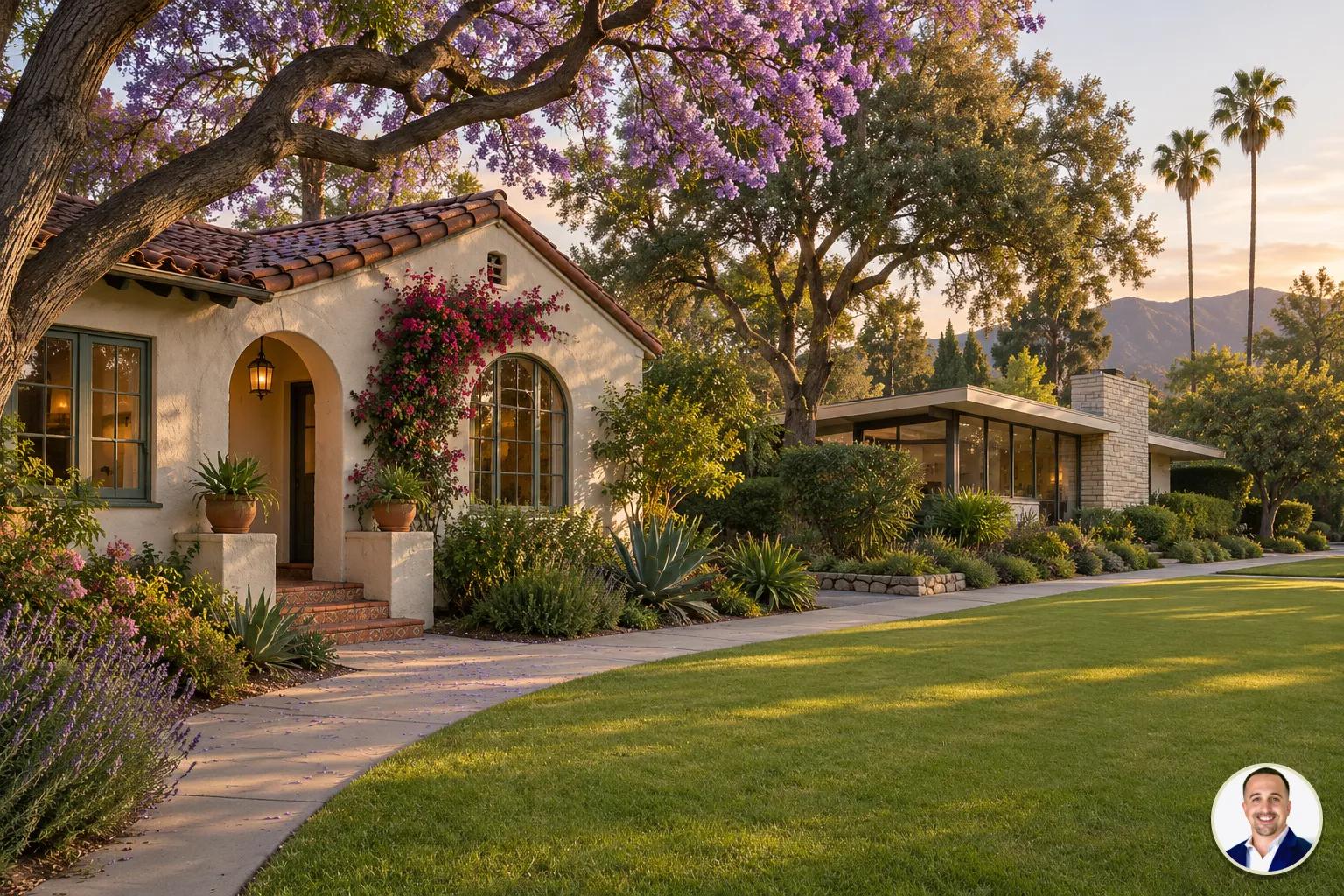
Restore a 1920s home if you want original windows, porches and trim and you are willing to keep them up yourself; buy mid-century if you want rooms that open to the yard. A 1920s home trades ongoing upkeep for original character, and a mid-century home trades it for open flow and different material questions. I'm Justin Borges, a Pasadena agent who works with character homes. I start with upkeep because you live with it every month. You can call me at (323) 673-2597 to talk through your tour list.
How much upkeep and project work do you want?
I ask buyers to look closely at the actual work each house needs and decide how much time they want to give it. In Bungalow Heaven, I look at the bungalow’s original details and ask what it takes to keep them. At an Upper Hastings Ranch Fickett house, I look at the connection to the yard and the condition of the materials before deciding what the project involves. For the wider style choice, start with which Craftsman, Spanish Revival, Tudor or mid-century home is right for you.
When a buyer wants to strip a 1920s house back to a blank slate, I start with this advice:
"This might sound counterintuitive, but I'm here to tell you, keep the character." (Justin Borges, November 2026 interview)
Whether a house is protected is a separate question from whether you should keep its character. Pasadena counts over 200 individual historic sites and 26 historic neighborhoods (City of Pasadena, Historic Places).
Put the work on your tour checklist: look at the original wood windows and porch on the older house, and ask about textured ceilings and paint materials on the mid-century house. I leave costs out of this page because they depend on the house and the bid. I also recommend asking your insurance provider about each property before you commit and looking at recent sold comparisons for each style when you weigh resale.
Ready to move forward? Let's talk.
How does the floor plan and yard flow differ between a 1920s home and a mid-century one?
| 1920s home | Mid-century home | |
|---|---|---|
| Character | Original windows, porches and trim, the details a landmark district protects | Picture windows and a full-size fireplace instead of period woodwork |
| Flow | Separate rooms, so a remodel can go one room at a time | Rooms open to the yard |
| Upkeep | Repairs to original wood and glass that you plan around | Fewer details to protect, with 1945 to 1978 ceiling and paint materials to check |
If you cook while watching a yard, mid-century wins on flow, and you can compare a 1950s ranch with a Craftsman bungalow in the SGV before you tour.
Pasadena's clearest mid-century example is Upper Hastings Ranch. The City of Pasadena's historic context statement says Coronet Homes developed it in 1951 as 800 homes, all designed by Edward Fickett, to embody Southern California's indoor-outdoor lifestyle: 1,300 square feet, three bedrooms, one and three-quarter bathrooms and a two-car garage, on lots starting at 7,200 square feet (City of Pasadena Historic Context Statement, public review draft, Chapter 8).
What does an inspector look for in a 1920s home?
On a 1920s house I ask the inspector to open the crawl space and attic and report on four things: the supply pipe, the drains, the plaster and the foundation. An older house may have galvanized supply pipe, cast-iron drains, plaster walls and an unbolted foundation. I ask the inspector to photograph the supply pipe so we can get a plumber’s assessment. Our 1920s Tudor inspection guide walks the same list for one Pasadena style, and you can text me your inspector's pipe and plaster notes.
For a wood-framed, pre-1980 home with a raised foundation, the Earthquake Brace + Bolt program offers up to $3,000 toward a retrofit. Households with yearly income of $94,480 or less may qualify for up to $7,000 more; ZIP code eligibility and registration also apply (California Residential Mitigation Program, EBB Retrofit).
The state contractor board gives a date for pipe insulation: asbestos-containing hot water and steam pipe insulation was manufactured from 1920 to 1972, and if it is in good condition the board says it is best left alone (CSLB, A Consumer's Guide to Asbestos).
Ready to move forward? Let's talk.
What does an inspector look for in a mid-century home?
For a house built between 1945 and 1978, the contractor board's warning is about ceilings and paint: many buildings built or remodeled in that window may contain a crumbly, asbestos-containing material sprayed or troweled onto ceilings or walls, and some textured paint sold before 1978 contained asbestos. Ask the inspector to point out every textured ceiling and every patched wall. Our 1950s mid-century inspection guide covers the rest of the walk-through, and you can call me at (323) 673-2597 with the inspector's textured-ceiling notes.
The federal Consumer Product Safety Commission banned asbestos patching compounds in 1977, and removing less than 100 square feet needs no asbestos certification, yet the contractor board says "the job is just as risky to perform," and Cal/OSHA still regulates all asbestos handling, so even small amounts a homeowner removes must follow strict transportation and disposal rules (CSLB, A Consumer's Guide to Asbestos).
Ready to move forward? Let's talk.
What does a Pasadena historic district change if you want to restore?
Bungalow Heaven is a designated landmark district, established by Ordinance 6368 on June 26, 1990 (Bungalow Heaven Conservation Plan, 2025 agenda text).
If you buy in a landmark district, plan on about 2 extra months for review of demolition, new construction or street-visible exterior work. You need a Certificate of Appropriateness before the building permit, and the review has no fee. Interior alterations, paint colors, landscaping and mechanical upgrades not visible from the street are outside that review; interior work can still need a building permit (City of Pasadena, Ordinance amending Title 17 historic preservation provisions; City of Pasadena, Historic Designations and Incentives).
Even outside a district, I recommend asking Design and Historic Preservation staff before planning major exterior work or a teardown. The city reviews demolition and major projects affecting houses eligible for designation (City of Pasadena, Ordinance amending Title 17, March 8, 2021). If you want to restore a Craftsman specifically, read whether to restore or renovate a Craftsman you want to buy, and then text me with the address.
The city's Mills Act program rewards a house that still needs work. Its 2026 guidelines limit single-family houses to a total assessed value of $2.0 million or less, with exceptions for works of Greene and Greene, designated Historic Monuments and properties listed individually in the National Register, and they require a plan for future rehabilitation, because properties already rehabilitated are ineligible. The house must be a designated landmark or monument, a contributor in a landmark or National Register district, or nominated for designation alongside the application. Because a purchase resets assessed value to about the price you pay, a house bought above the cap usually falls outside it unless it is one of the exceptions. The city may approve up to twenty new single-family contracts per calendar year (City of Pasadena, Historic Property Contract Program, February 2026).
For Pasadena owners who realize savings under a Mills Act contract, the city reports an average 51% reduction in property taxes. The contract is recorded on title and transfers to the new owner. Its initial term is 10 years and it renews each year; work affecting historic features, inside or outside, must follow the Secretary of the Interior’s Standards and receive a Certificate of Appropriateness (City of Pasadena, Historic Property Contract Program, February 2026).
Ready to move forward? Let's talk.
What do you check before you are bound to the purchase?
Federal rules for any house built before 1978, which covers both a 1920s and a 1950s house, give you the pamphlet "Protect Your Family From Lead In Your Home," the seller's known information on lead-based paint, all available reports on it and a Lead Warning Statement in the contract. They also give you a 10-day period to conduct a paint inspection or risk assessment, unless you and the seller agree in writing on a different period or you waive it in writing; the seller has no obligation to do any evaluation or reduction (EPA, Real Estate Disclosure).
Next, ask the seller whether a Mills Act contract is recorded on the house (City of Pasadena, Historic Property Contract Program, February 2026). If you need help confirming it, call me at (323) 673-2597 and I will ask the listing agent.
Ready to move forward? Let's talk.
Frequently asked questions
Can I use the Earthquake Brace + Bolt program on either house?
A mid-century house on a slab does not qualify. The 2025 eligible ZIP code list includes Pasadena 91101, 91103, 91104, 91105, 91106 and 91107; registration opens for a limited time each year (California Residential Mitigation Program, EBB Retrofit).
How does a Mills Act contract affect property taxes?
Owners with low Proposition 13 taxes may not benefit. Those who bought within the last 10 years at current market prices are most likely to benefit, and taxes do not increase because of the contract (City of Pasadena, Historic Property Contract Program, February 2026).
How do I look up a Pasadena house's permit history?
The city's Permit Center Online lets you research a property, search for a permit and check case status. Email [email protected] with permit questions (City of Pasadena, Permit Center).
How do I find what a property's tax bill will be?
Enter the address on the LA County Assessor Tax Portal to find the parcel's AIN, then use it on the Treasurer and Tax Collector site for taxes due and up to three years of payment history. Those are the seller's numbers: if the property is reassessed higher after you buy, a supplemental bill follows, generally three months to a year later, and impound accounts generally do not cover it (Los Angeles County Property Tax Portal, General FAQ).
Do Garfield Heights and Banbury Oaks follow the Bungalow Heaven rules?
Each has its own conservation plan, so check the plan for the address before planning exterior work (City of Pasadena, Agenda Report July 24, 2006, and Ordinance amending Title 17, March 8, 2021).
Sources
- City of Pasadena, Historic Places, checked 2026-11-24
- City of Pasadena Historic Context Statement, public review draft, Chapter 8, checked 2026-11-24
- CSLB, A Consumer's Guide to Asbestos, checked 2026-11-24
- City of Pasadena, Bungalow Heaven Conservation Plan, Attachment G (June 16, 2025 agenda), checked 2026-11-24
- City of Pasadena, Historic Designations and Property Incentives, checked 2026-11-24
- City of Pasadena, Historic Property Contract Program, February 2026, checked 2026-11-24
- EPA, Real Estate Disclosure, checked 2026-11-24
- California Residential Mitigation Program, EBB Retrofit, checked 2026-11-24
- City of Pasadena, Permit Center, checked 2026-11-24
- Los Angeles County Property Tax Portal, General FAQ, checked 2026-11-24
- City of Pasadena, Agenda Report July 24, 2006, Tournament Fields Landmark District, checked 2026-11-24
- City of Pasadena, Ordinance amending Title 17 historic preservation provisions (March 8, 2021), checked 2026-11-24

Justin Borges
Team Lead, The Borges Real Estate TeamDRE #01940318
With over 13 years in Southern California real estate, Justin specializes in probate sales, trust properties, and character homes.