

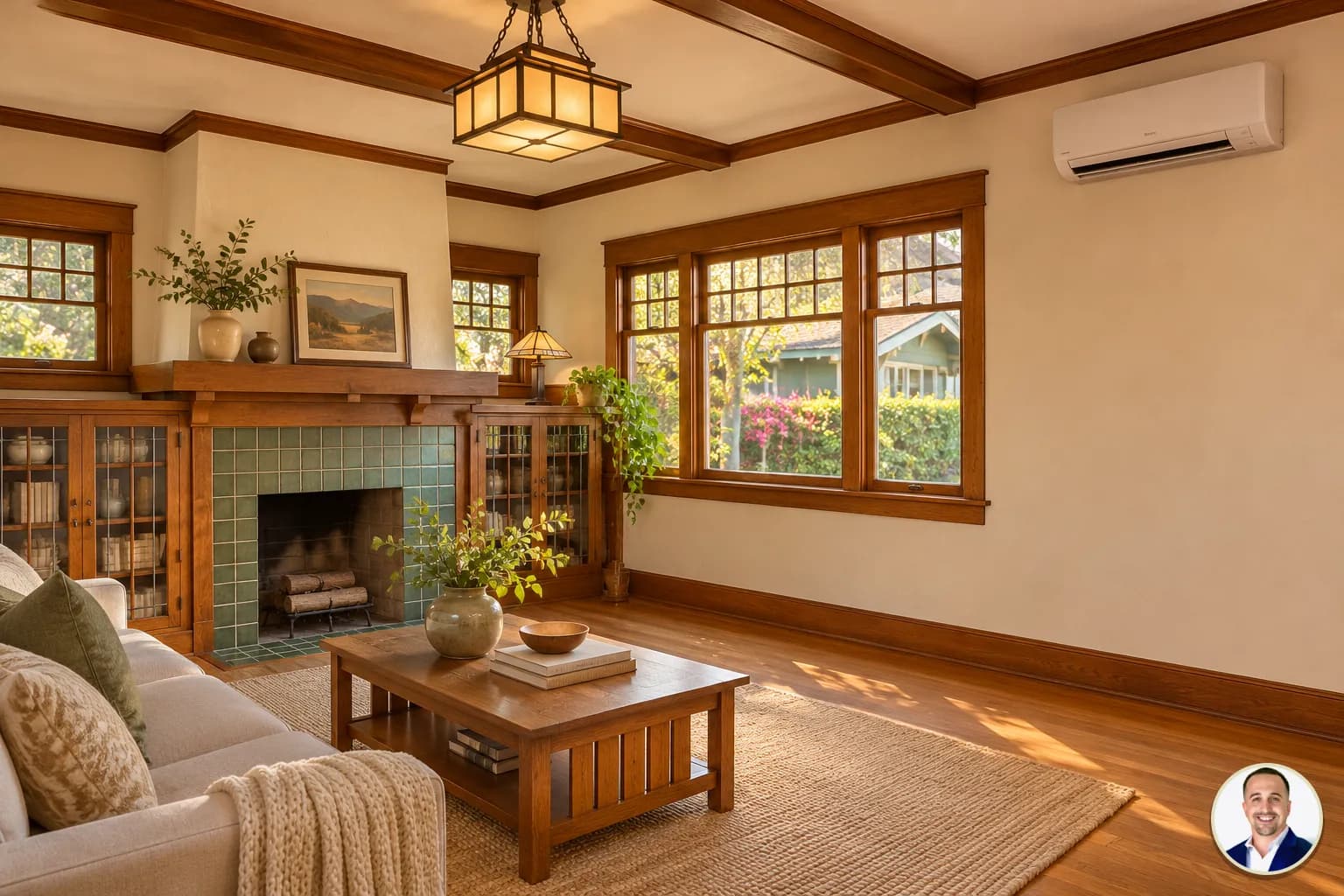
Yes, you can add heating and cooling to a Craftsman without ductwork, often with a ductless mini-split heat pump. I'm Justin Borges, a Pasadena and San Gabriel Valley realtor. My advice is to compare the floor plan, electrical capacity and permit requirements before choosing equipment.
That decision starts with how you actually live in the home. A quiet bedroom behind a closed door, a dining room with original built-ins and a sunny living room may call for different answers. Before an offer or a project, I want to know where the equipment would go and what the installation would change.
Ready to move forward? Let's talk.
Why might a Craftsman have no ducts?
A Craftsman may still rely on a wall or floor furnace, or it may have no central air and no distribution ducts. Those systems serve the house differently from a central system that sends conditioned air through ducts. A later owner may also have added individual room equipment, so do not assume that every room has the same service or that the current arrangement is original.
When you tour a home, ask the seller what heats and cools the home, which rooms are served, and whether there are permits and service records for the existing equipment. An inspector can help identify what is present and its visible condition. For the broader ownership picture, see what it is really like to own a Craftsman and what to inspect before buying in Pasadena.
If you are weighing a home and want to talk through the questions before an offer, call me at (213) 262-5092. I can help you make room for the right inspections in your decision. California guidance calls for a building permit for a space-conditioning appliance other than a plug-in room appliance.
What are the practical options?
The right comparison is not just the equipment. Ask where air will reach, what will be visible, and what must be opened or patched. The Department of Energy's Energy Saver Guide, checked 2026-11-05, describes ductless heat pumps and room air conditioners among the options.
| Option | What to discuss |
|---|---|
| Ductless mini-split heat pump | Indoor unit locations, room coverage, refrigerant-line route and outdoor equipment. |
| Small-duct high-velocity system | Whether a route for its smaller ducts and outlets fits the house without unacceptable changes. |
| Window or portable unit | Comfort in the room served, window or vent placement, and whether separate heat is still needed. |
| Conventional ducted retrofit | Whether the attic or crawlspace can accommodate ducts and where registers and equipment would go. |
Ask for a proposal that shows the actual route through your house. A small-duct system still uses ducts; it is a retrofit alternative, not a ductless system. A conventional ducted system may be worth comparing if the available spaces can accommodate it. Get a written bid for the installation cost and schedule, including electrical work, patching and permits. Check Pasadena’s permit fee schedule for city charges; ask the contractor about current utility or state incentives, since an amount is not established here.
Ready to move forward? Let's talk.
How does a ductless heat pump work?
The Department of Energy explains that a heat pump collects heat from outside and concentrates it inside when heating. For cooling, it collects heat inside and moves it outdoors. An air-source system exchanges that heat with outdoor air. A ductless mini-split is an air-source heat pump that can serve a home without ducts. See the DOE guide, checked 2026-11-05.
ENERGY STAR, checked 2026-11-05, describes an outdoor unit connected by refrigerant lines to one or more indoor units mounted on a wall or ceiling. That gives the contractor a way to plan around individual spaces, but it does not mean an indoor unit in the living room will necessarily make every closed bedroom comfortable.
Walk the floor plan with the contractor. Point out where you sleep, work and spend time, and ask what happens when interior doors are closed. Ask for the sizing calculation and a plain-language explanation of the proposed coverage. DOE advises working with a contractor on appropriate sizing; bigger equipment is not automatically a better answer.
For help comparing the home itself while you arrange those conversations, text me. A ductless system connects one or more indoor units to an outdoor unit, so the proposal should identify the rooms each unit will serve.
Where would the equipment and lines go?
A wall-mounted indoor unit will be part of the room you see every day. I recommend looking at it alongside plaster walls, wood trim and built-ins before agreeing to a location. Craftsman homes can be found in Pasadena’s Bungalow Heaven, where exterior placement deserves particular attention to historic review. A position that works on a drawing may feel different when you stand in the room and see how it relates to a window, a cabinet or a favorite piece of trim.
Ask the contractor to mark proposed indoor and outdoor locations, line routes and openings. ENERGY STAR notes that routing lines through spaces such as closets, garages, crawlspaces or attics can reduce wall patching. Ask what access is available and who will repair finishes. For a route through vermiculite insulation, follow the EPA warning, checked 2026-11-05: assume asbestos, leave it undisturbed and hire a professional asbestos contractor before work that would disturb it.
Ready to move forward? Let's talk.
What should I check about the panel and outdoor unit?
Ask when the electrical panel was installed or last changed, and have a qualified electrician evaluate the panel and the proposed load. The label or age alone is not a substitute for that assessment. Ask whether the proposal includes electrical work and whether the equipment location and line route depend on it.
Outside, walk the proposed location with the contractor. Consider how visible the unit and its lines will be from the street and from the spaces you use, as well as access for service. Ask the installer and city to confirm the particular placement requirements. For a designated property, involve Pasadena's Design & Historic Preservation staff before settling on a location.
The City of Pasadena, checked 2026-11-05, says mechanical upgrades not visible from the street are exempt from Certificate of Appropriateness review. Street-visible exterior equipment on a designated property may need review. Use that distinction when you review the proposed outdoor location. Read more about changes to a landmarked Craftsman.
Want another set of eyes on the buying questions? Call me at (213) 262-5092 and we can discuss what to investigate before you commit. Mechanical work not visible from the street is exempt from Certificate of Appropriateness review.
What does Pasadena require before work starts?
Start with Pasadena Building & Safety and describe the actual project. The California Energy Commission HVAC FAQ, checked 2026-11-05, says installing a space-conditioning appliance other than a plug-in room appliance requires a building permit. It also says new HVAC systems require load calculations and that most HVAC additions and alterations prescriptively require field verification and diagnostic testing by an ECC-Rater.
Pasadena's permit page, checked 2026-11-05, lists HVAC drawings for installing or replacing heating and cooling units. Ask the city which plans, energy documents and inspections apply to your proposal, including any electrical work. The California Energy Commission standards page, checked 2026-11-05, addresses the Energy Code; its new-construction heat pump provisions should not be read as a blanket requirement to replace an existing Craftsman's system with a heat pump.
Use a licensed contractor for permitted work. The Contractors State License Board bulletin, checked 2026-11-05, explains that the unlicensed minor-work exemption does not apply when a permit is required. Identify who will obtain the permit and retain the final documentation.
Ready to move forward? Let's talk.
What should a buyer ask before making an offer?
- What heating and cooling equipment exists, which rooms does it serve, and are there service and permit records?
- How old is the panel, and can an electrician assess it for the system you are considering?
- Where could indoor units, lines and outdoor equipment go? What plaster, trim or built-ins might be affected?
- Is the property designated or in a historic district, and what does city staff say about the proposed exterior location?
- Can a licensed HVAC contractor assess the floor plan, sizing, access and alternatives before you remove an investigation contingency?
Ask for enough detail to compare the proposals on the same rooms and scope. If a ducted retrofit is proposed, ask how the ducts will be sealed, insulated and tested. DOE's guide, checked 2026-11-05, recommends qualified professional attention to duct changes and testing. Maintenance matters after installation too: ask for the manufacturer's filter and service instructions. Our guides to yearly maintenance and Craftsman energy use cover the wider picture.
If you are working through a purchase, text me and we can identify the questions to take to your inspector and contractors. DOE advises cleaning or changing heat pump filters monthly or as needed, following the manufacturer’s instructions.
How do comfort and character fit together?
I do not recommend choosing equipment from a listing description alone. A house with beautiful trim and built-ins deserves a plan that shows both the comfort it can provide and the changes the installation will make. Ask for the proposed placement in writing, walk through it in person and make sure the contractor explains what remains uncertain until access is opened.
That same practical thinking applies elsewhere in a bungalow. Storage and closet space can affect where a line route is practical, while original windows deserve their own evaluation. Put the room coverage and the route around those features in the written bid.
Ready to move forward? Let's talk.
Frequently asked questions
Can a mini-split heat and cool a Craftsman?
Yes. A ductless mini-split heat pump can heat and cool without a duct system. A contractor should assess the rooms, equipment sizing and electrical capacity before recommending a layout.
Does every room need an indoor unit?
No. One indoor unit can serve a space, but closed doors affect how you plan coverage. Ask the contractor to explain which spaces each proposed indoor unit will serve and what comfort to expect with doors closed.
Does a mini-split need a permit in Pasadena?
A ductless installation requires a permit under the California Energy Commission guidance for space conditioning appliances. Ask Pasadena Building & Safety what plans, electrical work and inspections apply to the proposed installation.
Will a historic designation prevent an outdoor unit?
Not usually, if the unit is placed where it cannot be seen from the street. A street-visible unit on a designated property may need design review through a Certificate of Appropriateness first. Ask Pasadena's Design & Historic Preservation staff before installing.
Can I use a window or portable air conditioner instead?
A room unit can be an option for cooling a particular space, but it does not necessarily address heating or comfort throughout the house. Check the product and confirm applicable local requirements.
Should I upgrade the electrical panel first?
Not automatically. Have a qualified electrician assess the existing panel and the proposed equipment before deciding whether an upgrade is needed.
For help evaluating a Pasadena Craftsman, call me at (213) 262-5092. Bring your questions and we can plan the next conversations with the appropriate professionals.
Sources
- U.S. Department of Energy, Energy Saver Guide, checked 2026-11-05
- ENERGY STAR, Ductless Heating and Cooling, checked 2026-11-05
- California Energy Commission, Single-Family HVAC FAQs, checked 2026-11-05
- California Energy Commission, Building Energy Efficiency Standards, checked 2026-11-05
- City of Pasadena, Apply for Permit, checked 2026-11-05
- City of Pasadena, Historic Designations and Property Incentives, checked 2026-11-05
- U.S. EPA, Protect Your Family from Asbestos-Contaminated Vermiculite Insulation, checked 2026-11-05
- Contractors State License Board, Industry Bulletin 24-07, checked 2026-11-05

Justin Borges
Team Lead, The Borges Real Estate TeamDRE #01940318
With over 13 years in Southern California real estate, Justin specializes in probate sales, trust properties, and character homes. His expertise in 1031 exchanges and historic preservation has helped hundreds of clients navigate complex real estate transactions.