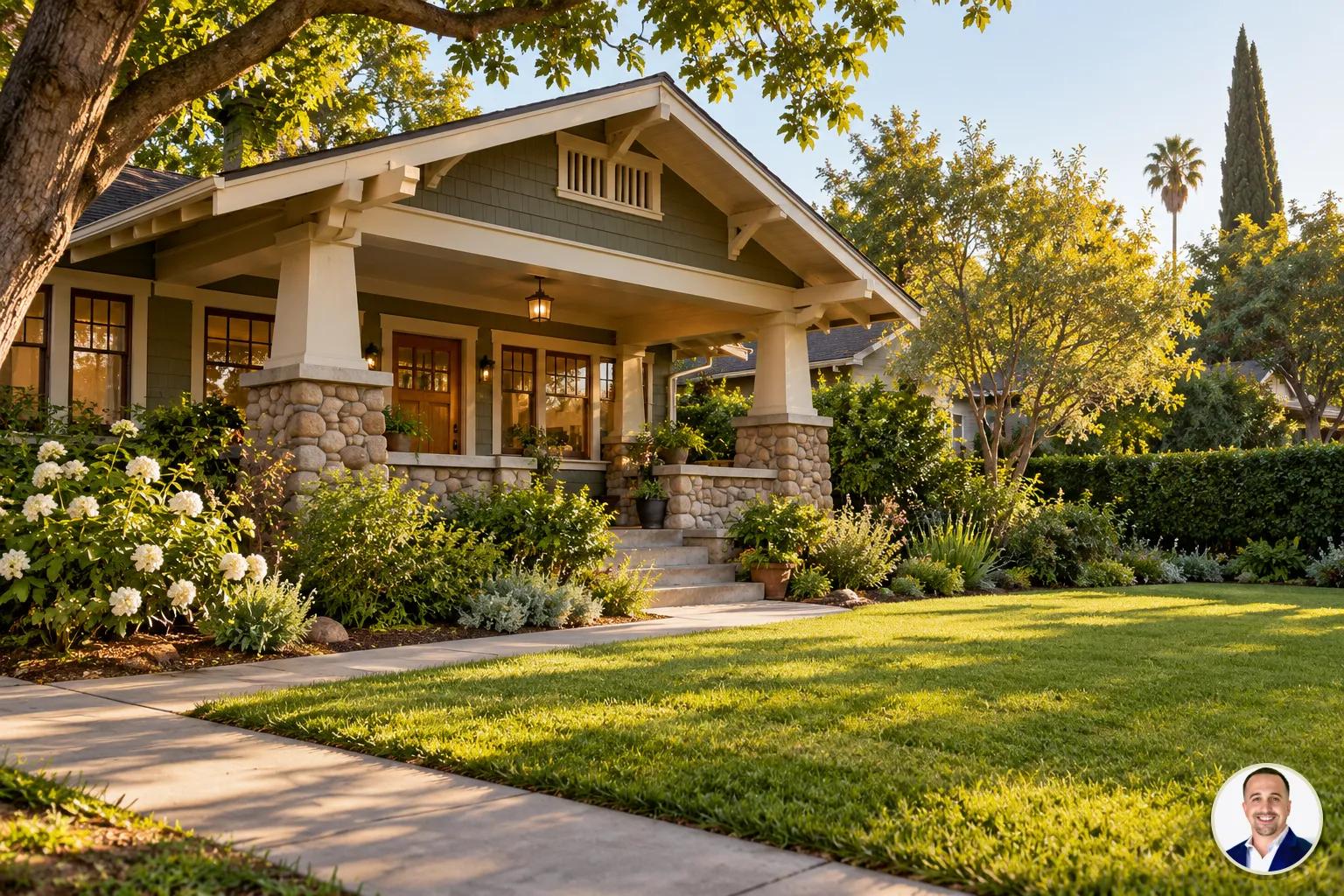
When I look for a real Craftsman in Pasadena, I look for features working together: a low-pitched gabled roof with wide eaves and exposed rafters, a deep front porch with tapered columns on piers, and built-in woodwork inside. A single detail does not establish originality; genuine Craftsman homes can vary or lose features. Pasadena’s design guidelines place the Arts and Crafts period around 1900 to 1925 (checked 2026-11-01).
Ready to move forward? Let's talk.
What should I look at before I walk inside?
Start across the street, where you can see the whole house. Notice the roof shape, the depth of the eaves and how the porch relates to the front rooms. Then walk closer and look underneath the roof edge. The most useful question is whether the parts belong together in scale and design, not whether a single attractive detail matches a listing description.
SurveyLA’s Arts and Crafts historic context, checked 2026-11-01, describes low-pitched gabled roofs, broad eaves, exposed rafter tails, braces, broad porches and natural materials among Craftsman characteristics. Its Craftsman bungalow description also emphasizes horizontal lines and a broad front porch. Those are a useful starting point, not a test that every house must pass feature by feature. If you want help reading the details, call me at (213) 262-5092.
I would take a moment to see how the porch roof meets the main roof and whether its supports feel proportionate to the house. A porch may be sheltered beneath the main roof or have its own roof. Stand on it and picture using the space, too. Identification matters, but you are also deciding whether you like the way the home lives. SurveyLA identifies broad porches and low-pitched gabled roofs as Craftsman characteristics.
Ready to move forward? Let's talk.
What do the porch and columns tell me?
Look at the columns from top to bottom. A tapered support becomes narrower toward the top; it may sit on a substantial pier. Notice the relationship between the column, pier and porch roof rather than focusing only on the outline. Look at the materials, the joints and the way the supports meet the porch floor. A support that appears newer is a reason to ask what changed, not a reason to dismiss the house.
There is room for variation. Pasadena’s historic district design guidelines, checked 2026-11-01, describe California Bungalow piers in brick, stucco or arroyo stone and say they may taper; plain wood posts are also common. A genuine bungalow does not need tapered piers to qualify as a Craftsman. If you have a question about a home, text me.
If the porch has been enclosed, try to understand its earlier shape. Can you see where openings or supports might have been? Ask for photographs or descriptions of past work rather than treating a visible seam as a definite answer. SurveyLA identifies enclosed porches among common alterations, alongside replaced windows. An alteration tells you something about the house’s history; it does not, by itself, tell you the date or quality of the work. Pasadena’s guidelines describe bungalow piers in brick, stucco or arroyo stone.
Ready to move forward? Let's talk.
How do I read the roof, brackets and rafter tails?
Look up at the edge of the roof. Wide eaves project beyond the wall, and exposed rafter tails are the ends visible underneath. Brackets or knee braces can appear beneath a gable. Walk around the house where access allows and see whether those details relate to the roof and walls as a whole. Photograph what you can see so you can compare it with records later.
Pasadena’s guidelines describe extended eaves, exposed rafters and beams, and typical knee braces. They also include more than one roof configuration: a low to moderate front gable is one pattern, while a side gable with a front dormer is another. A different roof line does not automatically mean a bungalow is a look-alike. Ask how the roof form fits the rest of the building. If you want help reading the details, call me at (213) 262-5092.
Fresh-looking brackets may be replacements, additions or carefully maintained older work. Appearance alone cannot settle the question. Look for differences in finish, fit and wear, then ask whether the seller has documentation. Do not pull at or disturb any component during a showing. Pasadena’s guidelines describe extended eaves and exposed rafters and beams.
Ready to move forward? Let's talk.
What should I notice about the windows and glass?
Look at the windows as groups as well as individual openings. Pasadena’s guidelines describe bands of double-hung or casement windows on California Bungalows. Notice their proportions, the spacing between them and how the frames meet the surrounding wall. Then look at the glass and any divisions within the sash. A coherent arrangement can tell you more about the design than a decorative pane viewed in isolation.
Ask which windows have been replaced, repaired or altered, and whether the seller has records. A newer window may sit in an older opening, so the frame, glass and opening need not all have the same history. Differences in materials or finishes are useful questions for a closer evaluation, but glass that looks old is not proof of its age. If you have a question about a home, text me.
There is a practical side to this observation. As you move through the rooms, see how the window placement affects light, privacy and furniture. If you like the house, ask an appropriate professional about the condition and operation of the windows. A style label cannot answer those questions for you. Pasadena’s guidelines describe bands of double-hung or casement windows on California Bungalows.
Ready to move forward? Let's talk.
Which built-ins and wood details should I examine?
Inside, look for built-in buffets, bookcases and fireplace surrounds. Notice how a cabinet meets the wall and floor, whether its trim relates to the door and window trim, and whether its proportions suit the room. Open a cabinet only with permission and look at the interior finish and joinery. Ask whether any pieces were restored, relocated or made to match older work.
Then look at the baseboards, door casings and flooring. Follow the trim from room to room and note where its profile or finish changes. A floor transition or a different casing might mark a later change, but it could also reflect a repair or an original difference between rooms. A showing gives you observations to investigate, not a definitive construction timeline. If you want help reading the details, call me at (213) 262-5092.
Do not make dark wood the deciding factor. SurveyLA explains that lighter painted interiors and plaster walls appeared in later bungalows, so painted trim can be original. Built-ins are helpful evidence when present, but they are not required to call a house Craftsman. A home can have lost original features, and a later remodel can add handsome new ones. Ask which pieces are known to be original and what evidence supports that description.
Pay attention to how these details fit your life. A built-in may give a room character and useful storage, while also shaping where furniture can go. If the floor plan raises a question for your household, our guide to whether a Craftsman bungalow is too small for a family explores that decision. SurveyLA describes lighter painted interiors and plaster walls in later bungalows.
Ready to move forward? Let's talk.
How can I separate an original from a later look-alike?
Start with the documented construction date and compare it with the style’s period, then examine the house itself. Pasadena’s guidelines place the Arts and Crafts period roughly from 1900 to 1925; the city’s Bungalow Heaven plan describes Craftsman as flourishing locally from about 1905 through the 1920s. That context helps frame a question, but a date alone does not establish the age of every feature.
If records show that a house predates the style, ask when Craftsman-looking features were added. If it was built later, ask whether it is a later interpretation. Either can be appealing; the distinction matters when originality is part of what you are buying. If you have a question about a home, text me. A recent spec home can borrow a porch, brackets or built-ins, so ask for its construction history instead of assuming decorative details make it a period bungalow.
| What I see | What I would ask |
|---|---|
| Period construction date and consistent details | Which features are documented as original, and which were repaired or replaced? |
| Older house with Craftsman-looking additions | When were the porch, trim or other features added? |
| Later construction with Craftsman details | Is the design a later interpretation, and what materials were used? |
| Mixed finishes or materials | Is there a record of remodeling, restoration or replacement? |
Compare wear and material across adjacent surfaces, but keep an open mind. Older material can be refinished; new material can be made to look worn. Look at proportions and how pieces fit, then seek dated photographs, plans or other records from the seller or available property history. A qualified preservation specialist can help assess evidence when the distinction matters to your decision.
Factory production is not the same as a later imitation. SurveyLA documents kit bungalows, including Craftsman models, and describes built-in furniture shipped assembled by a kit supplier. Likewise, a plainer house can be genuine: a National Register nomination for a Pasadena bungalow court, checked 2026-11-01, describes simplified details in later Craftsman bungalows. Neither a kit origin nor restrained ornament settles the question against the house. Pasadena’s guidelines place the Arts and Crafts period roughly from 1900 to 1925.
Ready to move forward? Let's talk.
How should I use these clues when deciding on a home?
Write down what you love and what you want verified. Separate a feature’s appearance from its documented history and its present condition. A remodeled kitchen or replacement windows may fit your needs perfectly, but if original materials matter to you, ask for specifics before treating the listing language as a guarantee. A preservation specialist can help you understand a feature; an inspector can help you evaluate condition within the scope of the inspection.
For the broader ownership decision, read is a Craftsman home a good buy in Pasadena? and our look at sales of older homes around Pasadena. You can also read about a San Gabriel bungalow sale; its style remains unconfirmed, so I would not use it as an identification example. If you want help reading the details, call me at (213) 262-5092.
If you want to compare homes in person, I can help you plan a buying-focused tour, and our Pasadena touring guide is a useful place to start. You can also browse Pasadena houses as you make your list. Pasadena’s guidelines place the Arts and Crafts period roughly from 1900 to 1925.
Ready to move forward? Let's talk.
Frequently asked questions
Does a Craftsman have to have tapered porch columns?
No. Tapered columns or piers are a useful clue, but Pasadena’s bungalow guidelines also describe plain wood posts. Look at the porch along with the roof, eaves, windows and the house’s history.
Can painted trim be original to a Craftsman?
Yes. SurveyLA describes later bungalows with lighter painted interiors and plaster walls. Paint alone cannot tell you when the trim was installed.
Are built-in bookcases required in a real Craftsman?
No. Built-ins can be compelling clues, but their absence does not disqualify a house. They may never have been there, or they may have been removed or changed.
Is a kit bungalow a real Craftsman?
It can be. SurveyLA documents kit bungalows, including Craftsman models. Factory preparation does not by itself make a period house a later imitation. If you have a question about a home, text me.
How can I tell whether a feature is original?
Compare its material, proportions, finish and wear with nearby parts of the house, then ask for records or historic photographs. Those observations are clues, not proof; a preservation specialist can help evaluate a specific feature.
Can a remodeled house still be a Craftsman?
Yes. A house can retain its Craftsman identity after changes, although the amount of original material varies. Ask what was retained, replaced or added rather than assuming the whole interior is original.
Pasadena’s guidelines place the Arts and Crafts period roughly from 1900 to 1925. If you want help comparing a home’s features, text me.
Sources
- SurveyLA Citywide Historic Context Statement: Arts and Crafts Movement, checked 2026-11-01
- City of Pasadena, Design Guidelines for Historic Districts, checked 2026-11-01
- City of Pasadena, Bungalow Heaven Conservation Plan, checked 2026-11-01
- National Register Registration Form, Court at North Lincoln Avenue, checked 2026-11-01

Justin Borges
Team Lead, The Borges Real Estate TeamDRE #01940318
With over 13 years in Southern California real estate, Justin specializes in probate sales, trust properties, and character homes. His expertise in 1031 exchanges and historic preservation has helped hundreds of clients navigate complex real estate transactions.