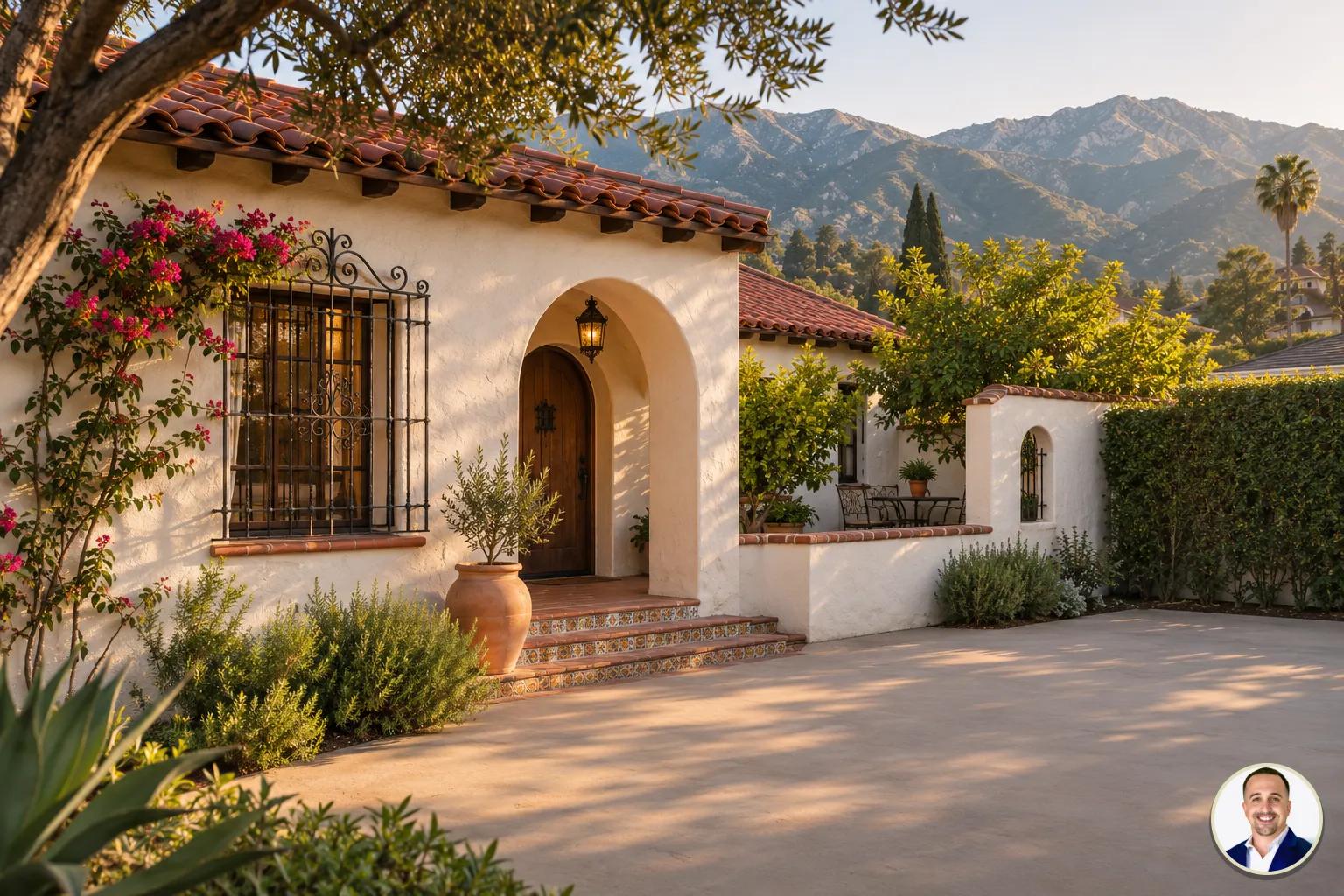
I'm Justin Borges. A Spanish Revival home is a California style associated with the period from 1915 into the 1940s, recognizable by stucco walls, a low-pitched clay tile roof, arched openings and wrought iron. Smooth stucco is a common look, although finishes can vary; the City of Los Angeles SurveyLA context and Pasadena design guidelines, checked 2026-11-14, describe the broader range.
What Spanish Revival features should I look for from the sidewalk?
I start with the whole shape of the house from the sidewalk, then move closer to the details. Look for a low roofline, stucco walls and openings that feel recessed into the wall. A red barrel-tile roof is a familiar clue, but tile can also appear as trim on a flatter roof. An arched entry or window can draw your eye toward the front door. Wrought iron may appear at a window grille, railing or gate.
I like to take a photo or notes from the public sidewalk and compare the features with the listing. When comparing homes, I would note which features stand out first and which ones become apparent on a closer look. Bring those notes to a tour, and ask about any differences between the listing description and what you see. That gives us a useful starting point for discussing the house. I would also note any questions that come up during the tour so we can follow up on them together.
Ready to move forward? Let's talk.
Which details help identify Spanish Revival style?
SurveyLA describes a combination of forms and materials rather than a mandatory checklist. Pasadena's guidelines describe recessed doors and windows, patios and heavy wood structural elements. Both sources were checked 2026-11-14. On a tour, I would look at how the entrance, roof and windows work together. Notice where an opening sits in relation to the wall and whether iron or tile draws attention to it. Indoors and outdoors, wood elements and a patio can add to the overall impression. I would look for:
- Stucco walls: A relatively uninterrupted wall surface, sometimes smooth and sometimes textured.
- Clay tile: A low-pitched roof with red barrel-shaped tile, or tile used along a roof edge.
- Arches: A curved opening at a door, window or covered walkway.
- Ironwork: Wrought iron at a window grille, gate or railing.
- Decorative tile: Colorful accents at an entry, stair or other detail.
- Outdoor rooms: A patio or courtyard that connects the home to an outdoor living area.
- Wood: A substantial wood door or exposed timber beams worth examining alongside the other clues.
Some homes are restrained; others have more ornament. Call me at (323) 673-2597 if you want help sorting through the details in a listing.
Ready to move forward? Let's talk.
How is Spanish Revival different from related styles?
Names in listings can overlap. I use the shape and arrangement of the building to guide a closer look. SurveyLA, checked 2026-11-14, describes these distinctions:
| Style | Clues to compare |
|---|---|
| Spanish Colonial Revival | Often asymmetrical, with stucco, low clay tile roofs or trim, arches and restrained wood, iron or tile details. |
| Mission Revival | A curved or scalloped parapet and a tower are defining clues. Spanish Colonial Revival can also have a tower. |
| Mediterranean Revival | Often more formal and nearly symmetrical, with a low-pitched hipped tile roof and arched openings. |
Stand back and trace the roofline and the placement of the openings. Is the facade balanced around a center, or do the parts form an asymmetrical composition? Then look for the details that support that impression. If you are comparing character homes, text me a listing you would like to discuss.
Ready to move forward? Let's talk.
How can records distinguish an older Spanish Revival home from a later lookalike?
A home with the same visual vocabulary may be a later interpretation. Check the year built in the MLS listing against county property records, and ask for an explanation if they differ. A date helps establish the building’s age; visible features may have been altered.
SurveyLA, checked 2026-11-14, places its Spanish Colonial Revival period of significance at 1912 through 1948 and says most examples were constructed before 1942.
Ask for available alteration records, prior descriptions and photos, then compare them with what you see. A changed window or addition may be part of the home's story. If preserving a particular detail matters to you, identify it before you make an offer and ask what is known about it. Pasadena’s guidelines place its Spanish Colonial Revival and Spanish Eclectic examples around 1920 to 1940. Call me at (323) 673-2597 to talk through the records and the questions they raise.
Ready to move forward? Let's talk.
What should a buyer do after spotting a Spanish Revival home?
Separate the features you love from the condition questions you need answered, and read what to inspect before buying. The National Park Service guidance on clay tile roofs, checked 2026-11-14, recommends experienced professionals for historic tile roof repairs.
For more detail, see our guides to clay tile roof repairs and stucco cracks. For help planning the search, see how to find a realtor for a Glendale Spanish Revival, or text me about a home on your list.
Our Glendale neighborhood guide can help you consider the surrounding area. In Glendale, Rossmoyne offers a chance to see a mix of Period Revival designs, including Spanish Colonial Revival, according to the City of Glendale district description, checked 2026-11-14.
Ready to move forward? Let's talk.
What else do buyers ask about Spanish Revival homes?
Is every stucco house with a tile roof Spanish Revival?
No. Stucco and clay tile appear in related styles, so I look at the composition, openings and details together. I compare the listing label with the whole building.
Does a Spanish Revival house have to have a courtyard?
No. A patio or courtyard is a useful clue, but a home can express the style through its walls, roof, openings and details without every feature on the list.
How can I distinguish Mission Revival from Spanish Revival?
Look for a curved or scalloped parapet and a tower as Mission Revival clues. Spanish Colonial Revival can also have a tower, so consider the whole building rather than relying on a single feature.
Can a newer house look like a Spanish Revival?
Yes. A home can borrow the look without being an original-period example. Compare the year built in the listing with county records and investigate discrepancies before treating the date as settled.
Does an original-looking exterior mean the house is in good condition?
No. Architectural appearance does not establish the condition of the roof, stucco or other systems. Review the available records and arrange appropriate inspections before deciding how to proceed.
Where should I start looking in Glendale?
Rossmoyne is one place to study a mix of Period Revival architecture, including Spanish Colonial Revival. I look at each home and its records.
When you are ready to compare homes in person, call me at (323) 673-2597.
Ready to move forward? Let's talk.
Sources
- SurveyLA: Mediterranean and Indigenous Revival Architecture, checked 2026-11-14
- City of Pasadena: Design Guidelines for Historic Districts, checked 2026-11-14
- City of Glendale: Rossmoyne Historic District, checked 2026-11-14 (search listing)
- National Park Service: The Preservation and Repair of Historic Clay Tile Roofs, checked 2026-11-14
These sources were checked 2026-11-14. For help putting these clues to work in your search, text me.

Justin Borges
Team Lead, The Borges Real Estate TeamDRE #01940318
With over 13 years in Southern California real estate, Justin specializes in probate sales, trust properties, and character homes. His expertise in 1031 exchanges and historic preservation has helped hundreds of clients navigate complex real estate transactions.